The major revision of the vibe-qc paper has been resubmitted. Alongside the scientific work, I have spent the past weeks making the software easier to obtain and use independently. The former monolithic repository has been split into vibe-qc, vibe-view, vibe-queue, and QVF, with public release mirrors on GitHub.
I am also looking for sponsors. vibe-qc is an independently developed quantum-chemistry project, and the costs of maintaining it extend well beyond writing code. Financial contributions, access to computing resources, and practical help from users can all make a difference. Below I explain what has changed and how individuals, research groups, and companies can support the work.
Why split the repository?
A single repository was a practical starting point. The calculation engine, viewer, scheduler, and file format developed together, and keeping them in one place simplified the build and testing infrastructure. A change to a calculation could be followed immediately through its output and into the viewer.
That arrangement was convenient for development, but less convenient for someone who wanted only one part of the software. A researcher should be able to use vibe-view with output from another quantum-chemistry program without first obtaining the vibe-qc engine. A developer interested in QVF should be able to work from the format specification and reference implementation directly.
The Quantum Visualization Format specification, schema, conformance examples, and reference implementations.
The applications can still be used together. The difference is that adopting one no longer requires adopting all of them. Separating the repositories has required work on packaging, dependencies, release procedures, and documentation. It should make external use and contributions more manageable as the projects grow.
Public mirrors, with development on our own server
The software was already distributed under open-source licenses. Source access was previously provided on request through deploy keys on our own server; the keys protected access to that infrastructure. The new GitHub mirrors remove that access step: anyone can browse or clone the public repositories directly.
An automatic mirroring mechanism publishes the code to GitHub whenever we release a new version of any of the four codebases. Development continues on our own server, where the build, testing, and development tools are integrated. GitHub provides the public release mirrors.
vibe-qc, vibe-view, and vibe-queue use the Mozilla Public License 2.0. QVF uses the Apache License 2.0. Each repository contains its license and documentation. If you want to inspect an implementation, try a tool, or build on the format, the GitHub organization is now a direct starting point.
A viewer that can be useful on its own
The viewer is a particularly useful reason for the split. Much of the work after a calculation consists of inspecting results: checking a geometry, identifying an orbital, examining a density, or understanding a periodic structure. Those tasks should not depend on which program performed the calculation.
A water orbital from the vibe-view tutorial. The two colors distinguish the signs of the orbital amplitude. Image from the project documentation.
vibe-view has terminal, desktop, and browser interfaces. Its separate repository allows it to be installed and developed independently of the calculation engine. QVF remains the default format, while TREXIO support in vibe-qc and vibe-view provides another route for exchanging calculation data. Work on QCSchema support is continuing.
A silicon structure from the periodic-system tutorial in the vibe-view documentation.
The viewer tutorial gives examples of working with molecular and periodic results. Contributions that improve imports, explain a workflow, or identify an awkward interaction are useful even when they involve no changes to the electronic-structure code.
What I want to build, and what support makes possible
The scientific aim remains the development of a general-purpose molecular and periodic quantum-chemistry code with agentic AI under expert human direction. Writing an implementation is only part of that work. It also needs comparisons with independent calculations, understandable documentation, reliable builds, and examples that other researchers can reproduce.
My longer-term interests include bringing correlated methods into the cyclic cluster framework for solids. That is ongoing research, with experimental work to be reported separately when it is ready. Maintaining the software used for the current calculations and developing new methods both require sustained time and computing resources.
The diamond-type silicon lattice, illustrated in the documentation. This is a structural schematic, rather than a calculated property.
I develop vibe-qc alongside my regular work and fund the project independently. The support pages describe the practical needs: development tools, suitable hardware, build machines, reference data, and the infrastructure used to distribute the software and documentation. More resources would allow broader testing across machines and larger scientific comparisons, as well as supporting the routine work needed to keep releases usable.
How to support vibe-qc
1. Make a one-time contribution
Ko-fi is the available route for a one-time financial contribution. Any amount is welcome. Small contributions help with recurring costs; larger contributions can help fund hardware, reference resources, or a particular infrastructure need.
Contributors can opt into the permanent supporter list. Public recognition is optional, and a name can be removed on request.
A compact logo or public name on the active sponsor wall, with a website link.
Gold
$100
A featured logo or public name, with a website link.
Platinum
$250
The largest logo or public name placement at the top of the active sponsor wall, with a website link.
Recurring support makes it easier to plan ongoing costs. The monthly checkout is still being configured, so please contact me at mpei@vibe-qc.com to discuss a recurring sponsorship. The sponsor page will carry the payment route when it is available.
Active sponsor recognition lasts for the period of support. Anyone who has contributed can also opt into the permanent supporter list, including former monthly sponsors.
3. Support the project as a company or research organization
If your organization uses the tools, has an interest in open quantum-chemistry software, or would like to support the infrastructure, please get in touch. We can discuss the published sponsorship levels or a larger contribution suited to a concrete need, such as a build machine or access to reference resources.
The code remains open, with no sponsor-only features. Sponsorship supports the project; scientific conclusions and validation remain independent. The sponsor page sets out the recognition policy and funding priorities.
4. Contribute hardware or access to computing resources
Useful support need not be a payment. Access to a suitable compute node, a high-memory machine, or additional build hardware can help test calculations and installation procedures on systems beyond those I own. Hardware donations can serve the same purpose.
Please contact me before making arrangements so that we can establish what would be useful and how it could be used. A machine that can run repeatable tests reliably may be more valuable than a short allocation on a much larger system.
5. Help improve the software and its documentation
There are several useful ways to contribute time and expertise:
Try an installation and report problems. Include the platform, version, commands, and error output so the problem can be reproduced.
Provide a small calculation that exposes an error. A minimal input and a well-defined reference are particularly helpful.
Contribute code, tests, or documentation. The separate repositories make it easier to work on the component you use.
Write or improve a tutorial. Clear examples lower the effort needed for the next person to try the software.
Offer scientific feedback. Method limitations, difficult cases, and comparisons with independent implementations help guide the work.
Cite and share the project when appropriate. A citation for software used in research, a link to a useful tutorial, or a recommendation to a colleague helps others find it.
Please follow the contribution guidance in the relevant repository. A precise bug report or a careful check of one calculation is a worthwhile contribution in its own right.
An invitation
The four repositories make it easier to use the parts of vibe-qc that are relevant to your work. The public mirrors make the source easier to obtain. I would now like to put the continuing development and maintenance on a firmer financial basis.
How an AI-assisted implementation turned Microsoft’s nonlocal neural exchange-correlation model into an experimental, reproducible provider for molecular and periodic density-functional theory, and where the validation boundary still lies.
Late one evening last week, I asked Codex to implement Microsoft’s SKALA exchange-correlation functional in vibe-qc. By the next morning, the first implementation was done. Over the following days we concentrated on the work that makes an implementation usable: reading the source paper, defining a general interface, adding periodic density projection, checking checkpoint provenance, writing tests, documenting the restrictions, and preparing examples that fail closed when a requested method is not yet scientifically supported.
The result is now part of vibe-qc as an experimental functional. The first molecular adapter shipped in v0.15.158; v0.15.160 expanded the experimental periodic infrastructure, including GPW, GAPW, and AICCM/four-centre entrances. Follow-up hardening on main tightens the high-level four-centre option forwarding and ECP guards for the next release.
This article is not an accuracy announcement for solids. It is an implementation report: what SKALA is, why it required a different XC interface, which molecular and periodic routes are present, what has been tested, and what has deliberately not yet been claimed.
What is different about SKALA?
Most exchange-correlation functionals used in electronic-structure programs have a local interface. At each quadrature point they consume a density and perhaps its gradient, Laplacian, or kinetic-energy density. A library such as libxc can evaluate those points in batches because the result at one point does not depend explicitly on all the others.
SKALA-1.1, introduced by Luise and co-workers at Microsoft Research, is different. It is a learned, nonlocal functional. In the authors’ notation its energy has the form
Excθ[ρ] = −(3/4)(6/π)1/3 ∫ [ρα4/3 + ρβ4/3] fθ(x[ρ]; r) dr.
The model starts from seven semilocal channels: the two spin densities, the squared gradient magnitude of each spin density, the kinetic-energy density of each spin channel, and the squared gradient magnitude of the total density. Those features are log-transformed and passed through a local branch in both spin orderings, with the results averaged to enforce spin-order invariance.
Nonlocality enters through a hierarchy of atom-centred coarse points. The architecture uses 16 radial functions and spherical harmonics through ℓ = 3, mixes equivariant coarse features, applies symmetric contractions for higher-body correlations, and repeats a downsample/process/upsample sequence three times. A scaled sigmoid constrains the enhancement factor to the interval stated by the authors. The complete checkpoint has 385,217 parameters, 331,265 of them in the local branch: compact by current machine-learning standards, but qualitatively different from a pointwise functional.
The original paper reports, under its own reference geometries and protocols, a GMTKN55 WTMAD-2 of 2.80 kcal mol⁻¹, an S22 mean absolute error of 0.14 kcal mol⁻¹, and W4-17 mean absolute errors of 0.92 kcal mol⁻¹ for the 183 single-reference cases and 1.23 kcal mol⁻¹ over all 200 cases. These are the authors’ benchmark results, not results produced by vibe-qc.
The important engineering consequence is simple: one grid point is no longer a sufficient unit of evaluation.
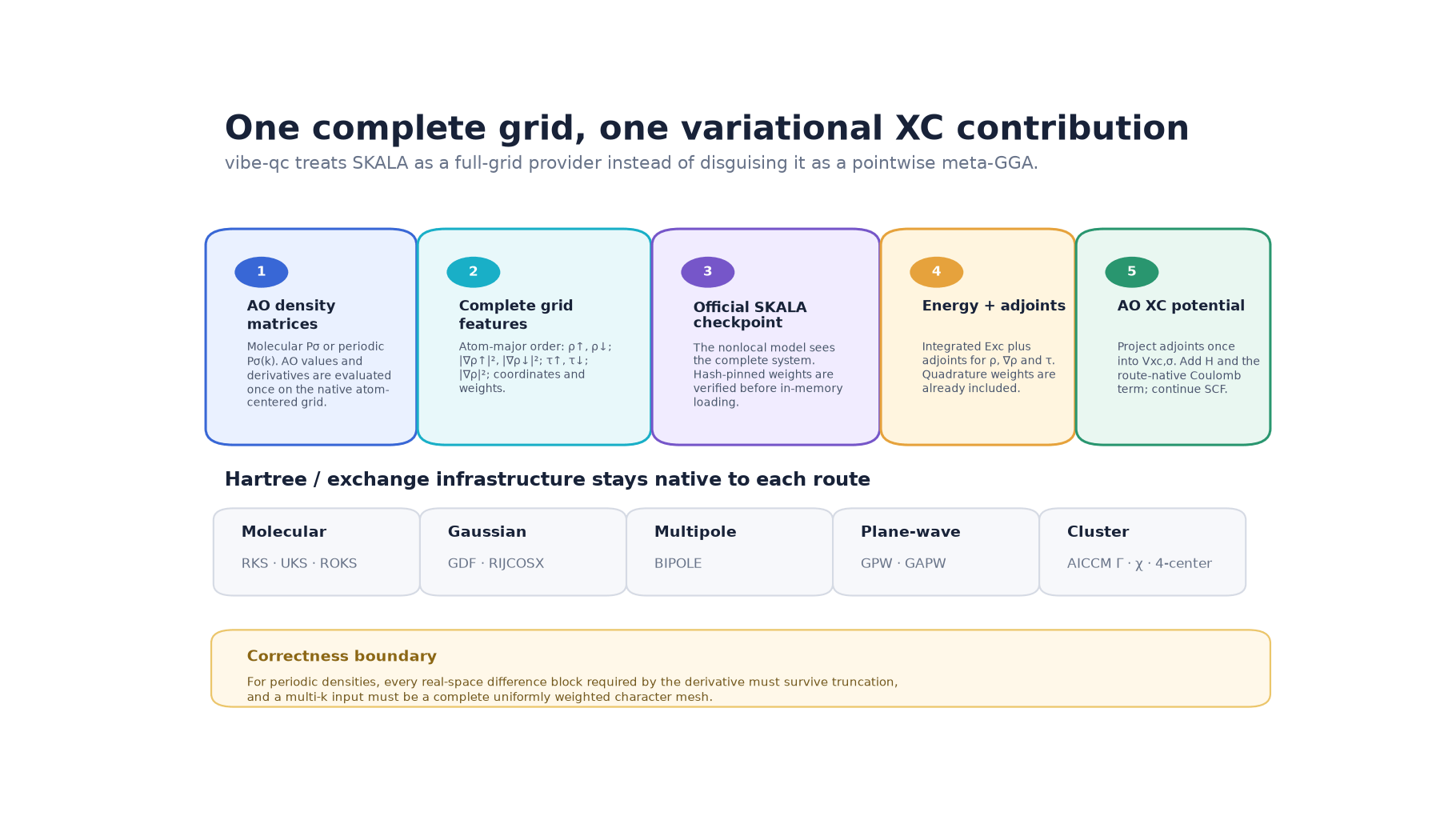
A full-grid XC provider
The most reusable part of this work is not a special if functional == "skala" branch. It is a versioned full-grid provider contract.
The host code assembles the complete atom-major quadrature grid and sends the provider the coordinates, final and atomic weights, atom ownership, molecular or periodic metadata, and the fields ρσ, ∇ρσ, and τσ. The provider returns one integrated exchange-correlation energy together with adjoints with respect to every input feature.
Those adjoints are then projected into the AO matrix:
Vμν,σxc = ∂Exc/∂Pμν,σ.
Expanded by the chain rule, this contains contributions through the density, density gradient, and kinetic-energy density. One easily missed detail is that the returned adjoints already contain the quadrature weights. Multiplying by the weights again in the AO projection would give a smooth-looking but wrong potential.
The provider boundary separates the learned XC model from the Coulomb machinery. Molecular integrals, GDF, RIJCOSX, BIPOLE, GPW, GAPW, and AICCM can keep their native Hartree construction while using the same full-grid XC contract. Open the figure for full resolution.
For a fixed geometry, the molecular path is consequently a two-pass operation:
Build every required feature over the complete grid.
Evaluate SKALA once and retain its integrated energy and adjoints.
Project those adjoints into the RKS, UKS, or ROKS AO potential and continue the SCF cycle.
The separation is useful beyond SKALA. Any future nonlocal model that can provide an integrated energy and consistent feature derivatives can use the same host boundary without becoming entangled with the molecular or periodic Coulomb backend.
Reproducibility starts before the first matrix multiplication
vibe-qc does not bundle Microsoft’s checkpoint or import another quantum-chemistry program at runtime. The optional skala extra provides the independent adapter and the compatible PyTorch runtime. The official CPU checkpoint is fetched on demand from its immutable upstream revision.
The contract records the expected byte size, SHA-256 digest, source revision, feature order, grid profile, protocol version, and D3 metadata. The bytes are verified immediately before TorchScript deserialization and are loaded from memory, avoiding a check-then-load race. Calculation manifests retain the checkpoint, execution, grid, data-type, and chunking provenance.
The current execution envelope is deliberately narrow: Linux CPU, Python 3.11 through 3.13, and PyTorch 2.12 or 2.13. A missing or mismatched checkpoint is an error, not an invitation to continue with a nearby file.
This also defines the redistribution boundary. vibe-qc ships its MPL-2.0 adapter and a hash-pinned on-demand fetch mechanism; it does not ship the model weights or Microsoft’s runtime. Our repository audit found no copyright or training-data-license blocker to that adapter/fetch design. It did not clear redistribution of the checkpoint itself, and it is not a patent freedom-to-operate opinion or an indication of Microsoft endorsement.
Periodic DFT is not molecular DFT with a unit cell label
For a periodic calculation, the spin density is assembled from lattice-resolved AO blocks. Schematically,
ρσ(r) = Σg Σμν Pμνσ(g) χμ(r) χν(r − g),
with analogous expressions for the density gradient and kinetic-energy density. After the model is evaluated, its adjoints must be differentiated back into the same real-space lattice blocks and then Bloch-summed into Vxc(k).
The central correctness condition is difference closure. If the active AO cells contain translations a and s, then the XC domain must retain every difference g = s − a required by the derivative. Truncating that difference set can yield an apparently converged energy paired with a nonvariational Fock matrix.
Multi-k support introduces another constraint. The transformation between k-space density matrices and real-space lattice blocks is a discrete Fourier transform. A complete, uniformly weighted Monkhorst-Pack character mesh has that structure; an arbitrary weighted list of k-points does not. vibe-qc therefore rejects meshes that cannot be expanded into the required complete set instead of silently treating them as equivalent.
The same separation of responsibilities is important for plane-wave-assisted methods. In GPW and GAPW, the native FFT or augmented Hartree builder remains active, while SKALA sees one complete AO density. GAPW deliberately does not evaluate the neural functional independently on smooth, hard, and soft components and then add those numbers: nonlocality makes that decomposition unjustified.
Current route map
The figure below summarizes the implementation state on current main. Every periodic row remains experimental and currently assumes zero-temperature occupations. “Integrated” means that the provider path exists and has contract-level tests; it does not mean that materials-level accuracy has been established.
The normal restrictions of each periodic Coulomb or cluster route still apply. The AICCM real-Γ, literal WSSC four-centre, and Chi-CCM constructions are distinct representations; evidence for one must not be transferred to another. Open the figure for full resolution.
In prose, the current scope is:
molecular RKS, UKS, and ROKS fixed-geometry single-point SCF;
GDF RKS/UKS at Γ or on a complete multi-k mesh;
RIJCOSX RKS/UKS on complete multi-k meshes;
3D BIPOLE RKS/UKS with the corrected Ewald gauge and an admissible complete mesh;
3D GPW RKS at Γ or on a complete unreduced multi-k mesh;
3D GAPW RKS at Γ, with one complete AO density supplied to SKALA;
neutral 3D AICCM real-Γ RKS/UKS;
route-specific 3D RKS/UKS entrances for the literal four-centre WSSC lineage and the distinct Chi-CCM four-centre backend.
The code fails closed for unsupported combinations rather than swapping functionals or dropping a derivative. Positive electronic smearing, DFT+U, most periodic ECP combinations, lower-dimensional AICCM variants, and external-provider hybrids remain outside the accepted domains of the relevant routes.
What has actually been validated?
The strongest numerical comparison so far is an offline, fixed-density oracle based on the official checkpoint for He/def2-SVP. It uses every one of the 7,936 grid points, not a sampled subset. The atom-major coordinates are bitwise and index identical to the upstream reference; the maximum weight difference is 7.11 × 10⁻¹⁵.
For both RKS and UKS, the exchange-correlation energy differs by −2.78 × 10⁻¹⁷ hartree. The maximum AO-potential matrix-element differences are 3.40 × 10⁻¹⁶ hartree for RKS and 6.73 × 10⁻¹⁶ / 5.27 × 10⁻¹⁶ hartree for UKS α/β. The committed oracle is strictly offline and imports neither PySCF nor the upstream SKALA Python package.
This is an interface oracle. It shows that the grid, energy, derivatives, and AO projection agree at numerical-noise scale for the tested density. It is not an end-to-end SCF benchmark and says nothing by itself about chemical or materials accuracy. Open the figure for full resolution.
Periodic finite-difference tests add a second kind of evidence. For Γ and complex multi-k perturbations they verify the variational identity
δExc = Σk wk Re Tr[Vxc(k) δP(k)].
That test is designed to catch errors in lattice-block closure, Fourier phases, Hermitian completion, and the projection of nonlocal adjoints. Again, it is implementation evidence rather than a periodic accuracy benchmark.
There is also useful independent molecular evidence. Pöschel and co-workers implemented SKALA through CP2K and GauXC using the same broad AO-density boundary. Under their protocols they report a dietGMTKN55 MAD of 1.255 versus 1.235 kcal mol⁻¹ in the reference implementation, a WTMAD-2 of 3.486 versus 3.446 kcal mol⁻¹, a reaction-by-reaction R² of 0.987, and a mean absolute cross-code residual of 0.085 kcal mol⁻¹. Their calculations are explicitly isolated molecules, not periodic solids, but they support the portability of the full-grid AO interface.
Orbitals and pictures: an important distinction
The new output path can preserve structures, basis data, orbitals, checkpoint provenance, and related artefacts in vibe-qc’s QVF format for inspection in vibe-view. That makes it possible to build useful visual workflows around a calculation without converting through another quantum-chemistry package.
The panel below is deliberately modest: it shows selected atomic-orbital basis functions for H₂O in the pob-TZVP basis. These functions are defined by the basis set. They do not depend on whether an SCF calculation uses SKALA, PBE, Hartree-Fock, or no electronic method at all.
Actual QVF/vibe-view renders. Blue and red mark opposite AO phases. These are basis functions, not occupied molecular orbitals, a SKALA density, or evidence for the quality of the functional. Open the figure for full resolution.
That caveat matters because attractive orbital pictures can easily outrun the science behind them. Molecular-orbital, localized-orbital, population, and QTAIM workflows are meaningful only after a real calculation has converged and the relevant property implementation has been validated. For periodic SKALA, band structure, DOS, COOP, and COHP reconstruction remain gated because the generic reconstruction path cannot yet reproduce the nonlocal XC potential. The current non-BIPOLE periodic population sidecar is also not a validated basis for scientific bond-analysis claims.
What remains gated
The present provider supplies the fixed-geometry ingredients required for SCF. It does not yet carry every derivative of the molecular grid, periodic image partition, or SKALA coarse points with respect to nuclear positions and lattice vectors. Therefore analytic gradients, geometry optimization, response properties, Hessians, Newton/TRAH solvers, and TDDFT remain gated.
Periodic dispersion is also gated until corrected-energy and citation provenance can be preserved coherently. Most ECP-bearing periodic combinations fail before setup. There is no published periodic SKALA reference energy against which the vibe-qc adaptation can yet be certified.
Most importantly, no solid, surface adsorbate, band structure, localized-orbital, or bond-analysis result from a real SKALA run is being presented here. The examples currently serve as executable inputs and dry-run plans. A successful SCF would still not be an accuracy validation.
The next scientific campaign is therefore intentionally conventional:
molecular energy and property parity for a small closed-shell system;
an S22B noncovalent dimer under a clearly specified geometry and basis;
a benzene calculation with molecular-orbital and localized-orbital output;
LiF at Γ and on a 2 × 2 × 2 mesh to test the periodic representation;
CO on MgO at near and far separations before discussing adsorption;
only then, band and bonding plots when the nonlocal-XC reconstruction path exists.
Those calculations are planned for the next release cycle after the dedicated SKALA runtime is deployed on the calculation host. Until they exist and have been checked, this article will not manufacture a periodic “result” from a smoke test.
The high-level runner selects the checkpoint’s pinned grid profile automatically. The output family records the SCF log, system and checkpoint provenance, routed references, structure, basis and orbitals. The worked SKALA tutorial continues from runtime setup through output inspection, while the SKALA user guide is the maintained route and restriction reference.
Release chronology and perspective
v0.15.158 introduced the initial experimental molecular SKALA adapter.
v0.15.160 expanded the experimental periodic infrastructure and AICCM/four-centre front door.
Current main contains follow-up route hardening intended for the next release.
Next release cycle is where the real molecular, solid, and surface validation campaign belongs; no version number is being guessed here.
What happened quickly was the first implementation. What took the rest of the week was turning that implementation into an inspectable scientific object: reading the equations, fixing an interface boundary, pinning provenance, testing the functional derivative, extending the idea to lattice blocks and k-points, writing down the gates, and refusing to convert an unrun example into a result.
That is the useful lesson from this experiment with agent-assisted scientific software. Speed matters. A much better measure, however, is whether the code makes it hard to forget what has and has not been demonstrated.
References and further reading
T. Luise et al., “Accurate and Scalable Exchange-Correlation with Deep Learning,” arXiv:2506.14665.
A job finishes on a cluster node at 2 a.m. and drops a QVF archive into your scratch directory. To look at the HOMO you can copy Cube files down to a laptop, start a GUI, and hope it parses the dialect your program wrote. Or you can stay in the same SSH session, run one command, and the orbital appears in the terminal. The first option works, most of the time. The second works in the session that already has the data.
vibe-view is my answer to that second path. It is a standalone visualization and conversion tool for quantum chemistry results, built outside of work, on evenings and weekends. It opens QVF calculation archives and loose structure and volume files from many chemistry programs. It is MPL-2.0 licensed, needs Python 3.11 or newer, and requires no C++ compiler and no Docker.
Every picture in this post is real output from the tool, rendered from real calculation archives that my validation campaign produced. Nothing here is a mockup, and none of the data was prepared for this article. More on that below.
No producer required
The design decision the rest follows from is that vibe-view does not require the code that produced the data. vibe-qc, the engine that writes most of my archives, is one QVF producer, but you do not need it installed, or even present, to open its results. The viewer installs into its own Python environment, so it never collides with anything else on the machine. The vibe-qc engine itself is described in a preprint on ChemRxiv and is under review at the Journal of Computational Chemistry. This article is about the viewer.
The product and the shell command are vibe-view, the Python package is vibeview, and the source directory is vibe-view/.
The same scene, five surfaces
The same renderers sit behind five surfaces. The browser surface is the default for interactive work: a full 3D viewer served over HTTP, with the section list in a sidebar and charts as interactive Plotly panels. The desktop surface wraps the same session in a native Electron window.
vibe-view open job.qvf     # browser
vibe-view desktop job.qvf  # Electron window
vibe-view tui job.qvf      # interactive terminal
vibe-view show job.qvf     # one frame, then exit
The desktop surface: a water RHF/6-31G* session in the native Electron window, HOMO rendered, SCF state as a badge in the title bar. The sidebar lists the archive’s sections, including three localized-orbital sets.
The terminal mode is the one I care about most. It draws the full 3D viewer, charts, and data tables as Unicode braille characters. It needs no display server, no OpenGL, and no X forwarding, so a result can be read on the compute node where it was written. This is benzene from my validation set, PBE0/def2-TZVP, exactly as vibe-view show prints it into an SSH session:
Benzene in a terminal. Every dot is a braille character. No display server, no OpenGL, no X forwarding.
Charts get the same treatment. This is the harmonic IR spectrum of formaldehyde, computed from a finite-difference Hessian at PBE0/def2-SVP, drawn as a stem plot with a Lorentzian envelope, in the terminal:
Formaldehyde IR in the terminal: the C=O stretch near 1800 cm⁻¹, the C–H stretches near 3000 cm⁻¹, transitions in orange, broadened envelope in gray.
And this is the energy profile of a benzene geometry optimization, taken from the trajectory section of the same archive as the structure above:
vibe-view show benzene_opt.qvf -s traj0 --chart: the last 0.07 kcal/mol of a geometry optimization, plotted in braille.
For figures there is a headless path. batch renders offscreen PNG galleries, capture renders any single section to PNG, and animate turns trajectories, reaction paths, and vibrations into MP4 or GIF. The same scene that draws in the browser renders to a PNG with no window open. The render_terminal function in the Python API uses the same software rasterizer and needs no OpenGL context, which is why the compute-node case works at all.
from vibeview import info, validate, capture_structure, render_terminal

print(render_terminal("job.qvf", size=(80, 24)))
In a notebook, %load_ext vibeview.jupyter followed by %vibeview calculation.qvf embeds the viewer in a cell.
What it renders
Structures render with CPK coloring in ball-and-stick, space-filling, or wireframe style. Electron density comes up as a translucent isosurface with an adjustable isovalue, and molecular orbitals render with signed lobes. This is the HOMO of the parallel-displaced benzene dimer, PBE0/def2-SVP with D3BJ dispersion, straight from vibe-view capture:
The HOMO of the stacked benzene dimer. Red and blue are the two signs of the orbital. One command, no window: vibe-view capture dimer.qvf -s vol_mo_0.The same archive’s total electron density as a translucent isosurface.
Vibrational normal modes animate. vibe-view animate wrote this GIF of a C–H stretching mode of formaldehyde from the same Hessian archive as the IR spectrum above:
A C–H stretching mode of formaldehyde, rendered to GIF headlessly with vibe-view animate -k vibration.
Beyond what is pictured: band structures and densities of states draw as interactive Plotly charts with a Fermi-level reference in the browser, IR, UV-Vis, and Raman spectra draw as stem plots, compare mode overlays structures from several archives with Kabsch alignment, and geometry optimizations play back frame by frame next to their energy plot. A few deeper cuts matter to me. The wavefunction evaluator re-evaluates any orbital on demand from the stored GTO basis, so an orbital can be inspected without asking the engine for another Cube file. Bond orders come from Mayer and Wiberg analyses, QTAIM critical points and bond paths overlay on the structure, and optional chain and secondary-structure metadata turns biomolecules into cartoon renders. There is also a live job-queue cockpit that follows vibe-queue jobs by state.
The desktop app’s orbital panel: pick an MO, choose the grid, render, re-localize, or compute density, ELF, NCI, and Laplacian volumes on demand. This is the wavefunction evaluator with buttons on it.
Files in, files out
Import covers QVF, XYZ, CIF, Cube, PDB, Mol2, Gaussian input, GRO, and SDF/Mol. Loose files from other codes open directly, without a conversion step. Export covers XYZ, CIF, CML, JSON, OBJ, glTF, POV-Ray and Blender scenes, a standalone self-contained HTML viewer, SVG, and PDF.
The utilities I reach for most: validate runs a SHA-256 integrity check over an archive, diff compares two archives, merge and slice recombine sections, supercell replicates a periodic cell, and h-add adds hydrogens. doctor diagnoses an installation. demo writes a bundled water example that needs no input file and no vibe-qc at all, which is how I test a fresh checkout before anything else.
Where these pictures come from
Every archive shown here is a by-product of the validation campaign behind the vibe-qc release paper. The benzene structure and its optimization profile are one archive from the molecular validation set. The formaldehyde Hessian comes from my input library, a growing collection of curated calculations that also feeds the ASCENT benchmark database. The benzene dimer archive carries the density, two orbital volumes, and a QTAIM topology in 7 megabytes. The point of showing campaign data instead of polished demo files is that this is what the viewer actually gets fed every day, at every basis-set quality, including the ugly ones. The desktop screenshots are the one exception: they show a fresh water RHF/6-31G* run made while writing this post, because a water HOMO is the clearest possible picture of signed lobes.
Honesty requires saying what did not make it into this post. My periodic test archives are minimal-basis, all-electron calculations, and their band structures render with core levels dominating the energy axis, which makes correct but useless screenshots. And while preparing this article I noticed that the terminal UV-Vis chart labels its axis in nanometers while plotting excitation energies in electron volts. The data in the archive is right, the label is wrong, and the bug is now filed. Writing a blog post turned out to be one more validation pass.
What is not done yet
I want the limits stated before you install, not after you hit them.
The private package index at vibe-qc.com is planned but not published, so pip install vibeview does not work yet. Installation today is from a source checkout or a linked wheel. Desktop mode requires a source checkout, and signed standalone desktop artifacts have not landed. The hosted 2.14.1 wheel predates the demo, doctor, formats, persistent import, and importer-plugin features, so a current checkout is needed for those. The vibe-qc GitLab project is still private at the time of writing. Read-only clone access is by request: email a public SSH key to mpei@vibe-qc.com.
Next I am working through the packaging checklist: the package index, the signed desktop builds, and a published wheel that matches the checkout. The terminal mode stays the centerpiece, because that is where the design proves itself: the result never has to leave the compute node for you to read it.
Short version of what it describes: a general purpose, open source electronic structure code for molecules and solids, written almost entirely through generative-AI-assisted programming under human scientific control. Molecular Hartree-Fock through coupled cluster, multireference methods and excited states. Periodic Hartree-Fock and DFT in one, two and three dimensions at multiple k-points through three different Fock-build routes. Its own results format, its own viewer, its own cluster-aware job queue, and a regression suite of more than 15,000 tests.
That part I have written about before. What I want to write about here is the machine that checked it, and what that machine has been doing since I clicked submit.
The validation loop
The interesting engineering in this project is not the SCF code. It is the thing that decides whether the SCF code is allowed to make a claim.
Every capability the paper promotes to production status is compared, on a canonical system, against an independent implementation running out of process. One reference per method family, matched to the formalism: ORCA for molecular methods, OpenMolcas for complete-active-space work, PySCF for the periodic density-fitting route, CRYSTAL23 for the bipolar-expansion route, GPAW for Gaussian-and-plane-waves. The point of running them out of process is that the comparison is then between two programs rather than between a wrapper and itself.
Around that sits a bounded controller. Not an unconstrained multi-agent search, which I think is a bad idea for anything that produces numbers you intend to publish. The controller applies one written method-maturity policy to a release-paper inventory, and runs calculation, result retrieval, scientific judgement, defect repair and paper promotion as concurrent lanes. A lane pauses only for a direct dependency, so a row with a confirmed defect waits for its fixed release while unaffected rows keep moving. It is closed by default, it requires an explicit human activation, and when it runs out of evidence-gated work it writes down a blocker and stops rather than inventing something to do.
The part that earns its keep is the pre-comparison audit. Before two energies are allowed to be compared at all, the controller checks method, basis, ECP, charge, multiplicity, frozen-core policy, integration grids, fitting, integral mode, symmetry, k-point sampling and solver controls. Most of what looks like a disagreement between two quantum chemistry programs is not a disagreement. It is two different calculations wearing the same label.
Scientific authority stays human throughout. The loop cannot promote anything. It can only produce evidence and refuse.
What it found after the paper went out
I expected the loop to go quiet after submission. Instead the five days that followed were the most productive stretch of the project, and they changed my mind about what this kind of tooling is for.
A real defect in the two-dimensional route. The paper discloses, as a limitation, that the graphene and hexagonal boron nitride examples returned a nonphysical negative band gap. That turned out to be two bugs stacked on each other. The visible one was an occupation-assignment error. Underneath it was a formula-level defect in the k-resolved nuclear attraction of the slab route, where a Bloch sum was conjugated as a whole instead of only the pair transform inside it, so the code was evaluating the potential at minus k. With that fixed, monolayer boron nitride converges at default integer occupations in nine iterations to a 6.510 eV indirect gap, matching an independent PySCF calculation on the identical cell to 0.17 mHa, with the correct electron count at every k-point and no smearing.
The way that one surfaced is the part worth keeping. The same defect had two completely different presentations: the insulator failed closed and never converged, while the semimetal converged in eight iterations to a silently wrong answer 0.16 hartree off. If the route had defaulted to finite-temperature smearing, the broken Hamiltonian would have converged everywhere, over-bound, with a green checkmark. The question I had queued as a decision, whether to smear two-dimensional systems by default, dissolved into its own answer: no, because fail-closed was the only reason the bug was findable.
A mechanism I had described incorrectly. The paper attributes the mixed-density-fitting failure on heavy-core systems to a loss of positive definiteness in the overlap. That was refuted by measurement. The real mechanism is that the linear-dependence cut on the plane-wave-dressed metric was retaining eigenmodes below the metric’s own construction error, and the inversion then amplified pure noise by a factor of several thousand. Fixing it improves the neon case by a factor of 26 and eliminates a divergence of several hundred thousand hartree on magnesium oxide. The dense-core class stays honestly gated, because the cut that removes the divergence discards most of the auxiliary space.
The paper’s principal open task, completed during review. The manuscript names completing the fitted Coulomb tails as the principal open task of the periodic stack. A cutoff ladder run after submission showed the picture is two regimes rather than one. On dense-core cells the reciprocal-space tail is decisive and the real-space lattice cutoff does nothing. On light cells the roles are exactly reversed. With both axes converged, the comparison against PySCF reaches sub-microhartree agreement. And the shipped default already closes the dense-core case, which means the task the paper named as its principal open work was quietly finished by the release line while the paper sat in the submission queue.
A printed number withdrawn. A band-gap row in the supporting information turned out to be produced by a defective route. An independent PySCF calculation on the identical cell, with the basis contractions verified and the k-set asserted equivalent, put our density-fitted value 229 mHa over-bound, with the error concentrated in the conduction band rather than spread uniformly. The row is out of the revision, and the subsection now reports the withdrawal as the finding, because that is what it is: the gap it returned was perfectly plausible on its own, and only a cross-route comparison exposed it.
And the converse, which is the best result of the whole campaign. On diamond, PySCF matches the bipolar-expansion route eigenvalue by eigenvalue to 0.4 mHa across all sixteen levels, with the mandatory triple degeneracy held to 0.0007 mHa, while the density-fitted route on the same configuration matches neither convention and breaks that degeneracy by 165 mHa. The paper presents the bipolar route as the one held on an unresolved convention. Measured against an external code, it is the route that survives.
Five things I did not know before
Converged is not correct. A selected-CI ladder reported convergence while sitting on a flat, wrong line, because the default spin treatment could not represent the determinants the problem needed. Its memory estimator, meanwhile, was returning a bit-identical 324 terabytes regardless of the requested size. Both were reported by the code as normal operation.
A plausible observable clears nothing. One collapsed periodic run was wrong by 3.45 hartree in total energy and printed an entirely reasonable band gap. If you validate on the derived quantity alone, that calculation passes.
Reference programs fail too, and you have to check them. The largest single deviation in the matched-reference population turned out to be ORCA converging to a metastable solution 23 mHa above ground from its default guess, condemned by ORCA’s own stability analysis and reproducing our value exactly with a different guess. A CRYSTAL reference had landed 11 hartree wrong and been accepted. A systematic screen afterward found seven reference-side artifacts, and refuted four candidates as genuine deviations of ours, which are now filed openly. Reporting both halves is what makes the first half believable.
The dangerous defect class is well-formed halves. Four separate times, an input parsed cleanly, ran, and produced a plausible number while being internally impossible: a lattice matrix transposed against its convention, a cell paired with a third of its atoms, an electron count inconsistent with its own multiplicity. The nastiest instance was a cutoff option that the code accepted, echoed in its output, and never applied, which was only caught by setting the same knob on two routes of one cell and noticing that one of them did not move.
Label the epistemic status of every clause. I printed a sentence with one clause marked as measured and one marked as inferred. An hour later the inferred half was refuted. Because the boundary was written into the sentence, the correction cost one clause instead of a paragraph. That felt pedantic when I wrote it and looks like the cheapest insurance in the paper now.
What is next
Three things, in order.
A paper on the semiempirical stack and its cyclic cluster model, which is the largest block of attempted work in the validation database and the smallest block of finished work. It has a real blocker in front of it, and it is not a scientific one: two of the reference engines are not installed anywhere on the compute fleet, so several hundred comparisons cannot be attempted at all until they are staged. That is a good illustration of where the actual cost of cross-code validation sits.
Then a proper announcement for vibe-view, which has quietly become the part of this project I use most and have written about least.
Then the ab initio cyclic cluster model, which is the reason I started building any of this. The release paper is deliberately the foundation for it rather than an attempt at it.
The code, documentation and tutorials are at vibe-qc.com, under MPL-2.0. Independent checks are very welcome, and after the last two weeks I would say that goes double for the periodic side.
QVF v1 grows up: basis sets, full reactions, and a reference viewer
The QVF v1 archive after the latest pass. New section kinds in amber.
Three weeks ago I argued that quantum chemistry needs a single, modern container format and introduced QVF as the candidate. The post laid out the goals: one zip per calculation, typed sections, explicit units, schema validated, sha256 per binary, vendor extensions under an x_<vendor> namespace, a controlled vocabulary of kinds that lets readers ignore what they do not understand.
The v0.4 spec at the time was deliberately a starting point. Three things were obviously missing.
The first was a way to ship the basis set and the MO coefficients alongside the rest of the calculation, so a viewer could render any orbital at any resolution without the writer baking everything to voxels first. The second was a way to package a full reaction in one section, with reactant, transition state, intermediates, and product called out as such instead of buried inside an opaque trajectory. The third was a way to express a difference of two scalar fields, the kind of “where did the electrons go” picture every reaction paper wants but no widely shared format names.
All three landed. v1 of QVF is now a richer container, the writer in vibe-qc emits all of them, and there is a working reference viewer called vibe-view that opens the archive in a browser tab. This post walks through what changed and how the implementation hangs together.
Three new section kinds
The QVF kind registry grew by three implemented kinds and a new field on the manifest. They are small additions in line count and large in what they enable.
wavefunction.gto carries the atom centered Gaussian basis (shells with centers, angular momentum, exponents, contraction coefficients) plus the MO coefficient matrix of shape [n_mo, n_ao]. A renderer that knows how to evaluate Gaussians can compute any orbital on a grid of its choosing. A renderer that does not know about it lists the section as “skipped, unsupported” and keeps using whatever pre-baked volume.orbital sections are also present. That fallback is the whole point of the controlled vocabulary.
reaction.path is a self contained reaction path. It carries frames as float64 [n_frames, n_atoms, 3] in Angstrom, byte identical to the existing trajectory binary layout, so every consumer that decodes a trajectory already decodes this. On top of the frames it adds a waypoints list, each entry naming a frame_index, a label, and a kind from a small enum (reactant, transition_state, intermediate, product, point). Energies are in Hartree, with the _eh suffix on the JSON key making the unit explicit.
reaction.waypoints is the lightweight counterpart. It carries only the waypoint annotations and points at an existing trajectory section via a trajectory_ref. Use it when the frames are already in the archive and you simply want to flag which frames are the TS or the intermediate. The validator confirms at archive time that trajectory_ref resolves to a real trajectory section and that every frame_index falls inside its frame range.
volume.difference is structurally identical to volume.density, a grid descriptor plus a 3D float32 or float64 binary, but it carries optional operand_a and operand_b fields. If one is given the other is required, and the validator confirms that both ids resolve to sections in the same archive. Viewers render the field with a diverging colormap centered at zero. Viewers that do not know the kind do not pretend it is a density, they fall through to “skipped, unsupported” per the partial support contract.
The manifest also picked up viewer_defaults.bookmarks, an ordered list of camera positions in the VTK convention (position, focal point, view up, plus exactly one of view angle for perspective or parallel scale for orthographic). Bookmarks give two things at once: consistent framing across viewers, and deterministic playback for movie export workflows. The schema enforces the perspective-XOR-orthographic constraint with a oneOf.
Why the basis set belongs in the archive
Pre-baked voxels are easy to consume. The wavefunction is cheaper to ship and infinitely more flexible.
The first post argued against shipping volumetric data as ASCII, on the grounds that a 200³ grid is around 8 million values and the modern era can afford binary. There is a related point that the first post did not make explicit. A pre-sampled orbital is a snapshot. Once written, the resolution is frozen, the bounding box is frozen, and the interesting region (which is rarely the entire bounding box) is also frozen. To zoom in or to render a different MO, the producer has to be re-invoked.
The Molden format figured this out in the 1990s. Ship the basis and the coefficients, evaluate at view time. wavefunction.gto follows that lineage, ported into the QVF container.
The contract is precise because vague Gaussian conventions are a famous source of silent bugs. Exponents are in bohr⁻². Contraction coefficients apply to normalized primitives, the same convention used by Molden, libint, NWChem, the .g94 files vibe-qc ships, and BSE downloads. Spherical (pure) shells use the m = −l, …, +l ordering. Cartesian shells use the libint lexicographic ordering over (i, j, k) with i + j + k = l, i descending then j descending. A pre-baked volume section can carry a wavefunction_ref back-reference so a re-sampling renderer can discard the blob and recompute at its own resolution if it prefers.
Periodic Bloch wavefunctions are out of scope for v1 of this kind. Crystal MO coefficients are k-resolved and supercell-sampled, which is a separate design pass. Producers must not emit wavefunction.gto for structures with any true entry in pbc. The schema does not enforce that yet (a periodic structure is a different section), but the validator and the renderers do.
Visualizing a full reaction in one section
One reaction.path section. Five waypoints. Frames and annotations travel together.
Reaction visualization has lived in an awkward middle ground for a long time. The frames are usually written as an XYZ trajectory, which is fine for playback but tells a viewer nothing about which frame is the TS or the product. The energies live in a separate log. The reaction coordinate, if anyone computed it, lives somewhere else entirely. To produce the standard “energy along the path with waypoints called out” figure, a script glues the three sources back together.
reaction.path collapses that into one section. The frames are there. The energies are there, in Hartree, one per frame. An optional reaction_coordinate array gives one scalar per frame for the x-axis when “frame index” is not the right unit. The waypoints list calls out which frames matter and what they are. A consumer that opens the archive has everything it needs to render the figure with no glue code.
The split between reaction.path (self contained) and reaction.waypoints (annotation over an existing trajectory) is a deliberate data flow choice, not a versioning hedge. A pre-computed IRC or single-step NEB run naturally produces frames plus waypoints in one go and emits reaction.path. A geometry optimisation workflow that discovers it was actually a reaction in post-processing already has a trajectory section and only needs to overlay annotations. Duplicating the coords in that second case would be wasteful and the validator can confirm the cross-reference resolves, so a lightweight annotation kind is the right shape.
Where did the electrons go
volume.difference with named operands. The viewer rejects pretending it is a density.
Difference density plots are everywhere in catalysis, photochemistry, and reactivity work. They are also represented inconsistently across tools. Some viewers do the subtraction at view time (which means the user has to load two density files and configure the difference). Others write the difference back out as a fresh density and lose the operand information. Neither is satisfying.
QVF takes the second path with one critical addition: the difference section can name the operands it was computed from, by section id, in the same archive. Sign convention is fixed (data = operand_a − operand_b) so there is no convention drift between producer and consumer. The validator resolves the names at archive time, so a producer that mis-spells rho_reactant fails the gate at write time, not later in someone else’s renderer. Viewers render the field with a diverging colormap centered at zero, which is the right visual encoding for a signed scalar field. A viewer that does not implement the kind reports it as “skipped, unsupported” and moves on, never trying to render it as a density with a single-sided colormap.
One schema, three consumers, zero drift
The schema is the contract. A sha256-identity test fails loudly if any copy of it drifts.
The most consequential change in this round was not a new kind. It was making the JSON Schema the single source of truth for the format and wiring it through the entire producer-validator-consumer triangle.
The canonical schema lives in the vibe-qc repository at python/vibeqc/output/formats/qvf_manifest.schema.json. The producer (write_qvf()) loads it and runs the manifest it just wrote through the schema before returning the archive path. A regression in the writer cannot ship a malformed manifest because the writer refuses to return one. The validator (validate_qvf()) loads the same file and uses it to gate everything: kind shape, required members, dtype names, binary shape rank, vendor namespacing, and the v1 const on the version field. The viewer ships a copy of the schema as a symlink to the canonical file, and a sha256-identity test in both test suites fails loudly if the symlink ever degrades into a divergent copy. Adding a new kind takes three coordinated edits (writer, schema, kind registry), and a drift-guard test asserts that all three stay in lock step.
A few things the schema cannot express end up as code in the validator. Cross-references are checked there: volume.difference.operand_a/_b must resolve, reaction.waypoints.trajectory_ref must point at a real trajectory, every frame_index must be in range. Binary member integrity is checked there too: every format: binary member’s len(bytes) must equal itemsize(dtype) * product(shape). A silent under-sized buffer or a dtype mismatch fails the gate at validation time. The sha256 in the manifest is verified for every member before use.
This is the part of the work I am most pleased with. The first post talked about “schema validation” as a virtue in the abstract. v1 turns that into infrastructure. Anyone who writes a QVF and runs it through validate_qvf learns immediately whether they have shipped a valid archive. Anyone who reads a QVF can rely on the schema as a contract, not a wish.
The writer in vibe-qc
The producer side, in python/vibeqc/output/formats/qvf.py, is a single file at this point with one entry point per section kind. The public API is small.
from vibeqc.output.formats.qvf import (
    write_qvf, validate_qvf,
    qvf_density_data, qvf_mo_data, qvf_wf_data,
)
The convenience helpers live next to write_qvf because evaluating a density or an MO on a grid is something the writer needs to do anyway, and exposing the same code as a one-shot helper means a user can package those outputs without having to learn the internal section dict shape. qvf_wf_data in particular is the helper that turns a converged SCF result into the wavefunction.gto payload: it walks the basis shells, normalises the AO ordering, attaches the MO energies and occupations, and detects restricted vs unrestricted automatically.
Two small but useful properties of the writer. First, every binary member is written with a sha256 attached in the manifest entry, computed from the bytes on disk. There is no separate hash pass at validation time. Second, the archive has a 1 Gvoxel ceiling per binary member (about 8 GiB float64 worst case), which is also enforced by the validator. The two ceilings are pinned to the same constant in the source so a payload the writer accepts cannot later be rejected by the validator as “too large”.
Test discipline is the boring part that matters. Round-trip tests run write_qvf followed by validate_qvf on every implemented kind, then re-open the archive and decode the binary members. Drift-guard tests assert that the writer’s _IMPLEMENTED_KINDS registry, the schema’s oneOf branches, and the viewer’s SUPPORTED_KINDS stay aligned. Failure-path tests exercise the cross-reference checks (operand_a without operand_b, trajectory_ref pointing at a non-trajectory section, frame_index out of range) and confirm the validator catches them.
vibe-view: the reference viewer
vibe-view in the browser. Sidebar is the section list with status. Viewport is PyVista marching cubes on the GPU. Lazy load on first click.
The first post promised a viewer. vibe-view is now in the repository as a peer sub-project of vibe-qc, with its own pyproject.toml and CLI entry point. Open a QVF with one command:
pip install -e 'vibe-view[gpu]'
vibe-view open h2o_pbe0.qvf
The stack is PyVista + Trame, both pure Python on top of VTK. There is no JavaScript build step, no npm lockfile, no two-language project. The tradeoff is that the UI is server-rendered and ships pixels over a websocket, which is a fine choice for a viewer that should “just work” after pip install and a poor choice for a viewer that needs to run inside a web page someone else owns. The Trame backend lets you embed if needed, but the default mode is “open in a browser tab against a local server” and that covers the common case.
The viewer is small and the architecture is deliberately shallow. The QVFReader in qvf.py opens the zip, validates the manifest against the schema (the same schema as the writer), parses sections into dataclasses, and exposes typed accessors. Each kind has one renderer file under renderers/ and a one-line entry in the dispatch table. The application layer in app.py wires the sidebar, the viewport, the per-kind hint panels (isovalue slider for volumes, MO selector for wavefunctions, frame slider for trajectories and reactions), and the camera bookmark controls.
Four rules govern the partial-support contract, and they show up at the file boundaries.
Rule 1: supported kinds are declared in a single explicit set. No clever inference, no inheritance, no implicit “everything that looks like a volume should render”. A kind is in the set or it is not.
Rule 2: unknown kinds are classified as “skipped, unsupported” and listed in the banner. They are not errors. An archive with a future kind the viewer was not built against still opens, still renders everything else, and tells the user what was passed over.
Rule 3: vendor-namespace kinds (x_<vendor>.*) have their vendor name extracted and shown next to the skipped-reason. A reader can quickly see whether an archive was produced by a specific vendor toolchain by glancing at the banner.
Rule 4: every member’s sha256 is verified before its bytes are used. JSON members and binary members both. A mismatch is a hard error for that section only, and the viewer continues rendering the others. The failing section is marked “error, sha256 mismatch” in the banner.
The wavefunction renderer is the most interesting one to look at. It walks the basis shells, evaluates the primitive Gaussian normalisation (spherical for the radial part, plus a Cartesian per-component correction for l ≥ 2), generates the angular factors in the file’s AO order (libint lexicographic for Cartesian, m = −l, …, +l for spherical), and sums Σ c_µ χ_µ(r) on a Cartesian grid auto-sized from the atomic bounding box. The output is a dense float32 volume that flows into the same VolumeRenderer that handles a pre-baked volume.orbital, so isosurface rendering is shared. Shells with l > 3 are silently skipped, which loses accuracy on basis sets with g and h functions and keeps the viewer usable for the overwhelming majority of files. The full evaluator is on the roadmap.
The reaction renderer reuses the trajectory animation machinery (because the binary layout is identical) and layers the waypoint markers onto the energy curve. Click a waypoint and the viewer jumps to that frame. The energy plot is rendered server-side via matplotlib and shipped as a PNG, which is good enough for a 2D plot and avoids pulling in a second plotting stack.
What comes next
Several kinds are in the registry as “reserved”: volume.potential (electrostatic potential maps), volume.orbital_projection (NTO and IBO projections), topology.qtaim and topology.elf_basins (atoms-in-molecules basin meshes), and projections.lcao (LCAO projections of band wavefunctions). The validator accepts them today so a vendor producer can ship them ahead of the canonical writer, but the writer does not emit them yet. They will land as the upstream computations land.
The periodic wavefunction.gto question is the next real design pass. Bloch wavefunctions are k-resolved and the right way to package them is not obvious. A list of k-points each with its own MO coefficient block is the naive answer and is probably wrong because the natural consumer is a re-sampling renderer that wants to evaluate a single Bloch state on a supercell grid. I would rather get this one right than ship it fast.
On the viewer side, the obvious gaps are recordable movies (the bookmarks infrastructure is in place, the encoder is not), a proper file dialog so users do not have to type a path, and the higher-l shells in the wavefunction renderer. None of these are format changes. They are viewer work.
For other codes and visualization tools
The invitation from the first post stands and is now easier to act on. The format is specified, the schema is enforced, the writer is open source under MPL 2.0, the validator runs against any archive, and a reference viewer demonstrates the full v1 surface end to end. Adding a writer for QVF to another QC code is the kind of task a small focused effort can finish in a few days. Adding a reader for the kinds you care about is the kind of task a coding agent can finish in an afternoon, given the schema and a few example archives.
If you produce orbital and density data in a QC code, please consider emitting wavefunction.gto rather than (or alongside) pre-baked cubes. If you produce reaction-path data, please consider emitting reaction.path instead of yet another bespoke trajectory variant. If you build a viewer, please consider adopting the four-rule partial-support contract so unknown kinds are listed, not errored. Each of those choices costs the producer or the consumer very little and makes the ecosystem dramatically more useful for the next person who picks up your file.
The specification, the writer, the validator, and the vibe-view source are all in the vibe-qc repository. The design document lives at docs/design_qcv_format.md. Feedback, adoption notes, and proposals for new kinds are welcome at mpei@vibe-qc.com.
Quantum chemistry calculations in 2026 produce rich, many layered results. A single run can generate atomic structures, volumetric grids for densities and orbitals, band structures, vibrational modes, spectra, trajectories, and detailed provenance describing how the calculation was performed. In principle, all of this belongs together as one coherent dataset.
In practice, it does not.
Instead, results are fragmented across a collection of loosely related files: cube files for densities, XSF for periodic systems, XYZ for trajectories, vendor specific binaries for restart data, and a mix of text, JSON, or ad hoc logs for energies and convergence. Each file captures a slice of the calculation, but none captures the whole. There is no shared manifest, no consistent schema, and often no reliable record of provenance.
This fragmentation is not just inconvenient. It is a structural limitation that has persisted for decades.
The real problem: an aging ecosystem
The freeze line in QC visualization tools
The issue is not only the number of formats, but the state of the tools that use them.
A look at the visualization tools that quantum chemists actually reach for shows a field that is partially active and partially frozen in place. Before listing them, one distinction matters. A pure orbital or density viewer exists to look at the output of a QC calculation: orbitals, densities, electrostatic potentials, NTOs, IBOs, ELF, and so on. A molecule editor with a built in renderer exists primarily to build and edit structures, and happens to visualize cubes as a secondary capability. Avogadro 2 is the latter. So is Gabedit. So is GaussView. So is every vendor GUI tied to a specific QC engine. The distinction matters because the editor category has steady commercial backing (Schrödinger, Gaussian Inc., SCM, Wavefunction, TURBOMOLE GmbH), while the pure viewer category is overwhelmingly academic and overwhelmingly thin.
Pure orbital and density viewers, still maintained
Tool
Latest release
License
Multiwfn
Apr 2026 (rolling), 3.8 stable (Jan 2026)
Free, permissive, academic and commercial
Pegamoid
Aug 2025 (last commit), 2.12.4 active 2024 to 2025
GPL
MOrbVis
Active 2025, WebGPU based
Open source
IQmol
Jul 2024
Open source, Q-Chem affiliated
Molden / gmolden
Oct 2023
Free, proprietary terms
IboView
Jan 2022
Free, custom license
QMForge
Feb 2020
GPL. Slow to stall.
Speck
2017 to 2020 era, sporadic
MIT
Editors and full GUIs that include a renderer, still maintained
Tool
Latest release
License
Avogadro 2
Apr 2026
BSD 3 clause / GPL v2, open source
AMSview (AMS GUI)
2026.1
Commercial (SCM)
TmoleX
2024.1 era
Commercial (TURBOMOLE, COSMOlogic)
Maestro / Jaguar GUI
2026.1 era
Commercial (Schrödinger)
Chemcraft
2024, ongoing
Commercial. Free non saving demo.
wxMacMolPlt
Jan 2024
GPL
Spartan
Spartan’24
Commercial (Wavefunction)
Vipster
1.20.0 era, active 2023 to 2024
GPL
Gabedit
Jul 2021
GPL
GaussView
2019
Commercial (Gaussian, Inc.)
Web and JavaScript stack, still maintained
Tool
Latest release
License
Notes
Jmol / JSmol
Mar 2026
LGPL 2.0
Reads cube, molden, fchk
3Dmol.js
Jan 2026
BSD
Loads cube and VASP data, isosurfaces
Mol* (mol star)
Active 2024 to 2026
MIT
Successor to NGL and LiteMol
NGL Viewer
Core 2.x maintained, NGLVieweR 1.4.0 (Nov 2024)
MIT
Primarily structural biology, reads cube
Miew (EPAM)
Active
MIT
Mainly biomolecular
iCn3D (NCBI)
Active
NIH
Mainly PDB, has cube support
Periodic, crystallographic, and materials oriented
Tool
Latest release
License
Mercury (CCDC)
2024.3.0 era
Free base, full version needs CSD license
VESTA
Aug 2022
Free for academic and non commercial
Olex2
1.5 era, active
Free with citation
CrystalMaker
11.x era
Commercial
Diamond
5.x (Crystal Impact)
Commercial
XCrySDen
Oct 2019
GPL v2
Biomolecular tools routinely used for orbital cubes
Tool
Latest release
License
PyMOL
Feb 2025
Schrödinger commercial. Open source build available.
UCSF ChimeraX
2024 to 2025
Free academic, commercial fee
UCSF Chimera
1.19 (2024). Considered legacy, succeeded by ChimeraX.
Free academic
VMD
1.9.3 stable (Nov 2016). 1.9.4 RC and 2.0.0 alpha Unix in 2025.
Free non commercial, custom license
The graveyard
A larger group of QC visualization tools has either explicitly retired, last released a decade or more ago, or sits in maintenance limbo with sporadic patches. Several of these were dominant in their era.
Tool
Last release
Status
MOLEKEL
5.4 (Aug 2009)
Abandoned. Code on GitHub. GPL.
gOpenMol
3.00 (2005, Windows binary 2010)
Dead. Original CSC Finland page gone.
Viewmol
2.4.1 mid 2000s, last activity ~2009
Dead. GPL.
RasMol
2.7.5.1 (Jul 2009)
Effectively dead, but the protein chestnut. GPL.
ArgusLab
4.0.1 mid 2000s
Dead. Long promised Qt and iPad ports never appeared.
QuteMol
0.4.1 (Jun 2007)
Dead. GPL with citation.
ECCE
7.0 official PNNL (Aug 2013), fork 7.3.2 beta ~2017
Effectively dead. ECL 2.0.
GaussSum
3.0.2 (2013)
Effectively dead. GPL. Built on cclib.
MoleCoolQt
2.4 era, sporadic commits
Largely dormant. Charge density oriented.
Luscus
Source side ~2016 to 2018
Stagnant. Academic Free License v3.
MOLDA
Early 2000s
Dead. Site gone for years.
PyMOlyze
Early 2000s
Dead. Rolled into QMForge philosophy.
MOLMOL
2K.2 era (ETH Zurich)
Dead. NMR oriented but used for structures.
HyperChem
8.0.10 (2011)
Effectively dead. Still sold by Hypercube.
Cerius2
Last Accelrys release ~2007
Dead. Replaced by Materials Studio.
InsightII
Last Accelrys release ~2005
Dead. The SGI workstation era classic.
MacMolPlt (original)
Pre 7.0, mid 2000s, Carbon
Long superseded by wxMacMolPlt.
What the landscape shows
The actively maintained pure orbital viewers are a short list: Molden, IboView, Multiwfn, Pegamoid (for OpenMolcas users), and MOrbVis (a recent WebGPU upstart). IQmol fits here too if classified as a viewer rather than a builder. That is essentially the full set. Everything else is either an editor with a renderer attached, a primarily biomolecular tool repurposed for cube files, or a vendor GUI tied to a specific QC engine. VMD straddles categories. The stable 1.9.3 from 2016 is what most people still run, while 1.9.4 release candidates and the 2.0.0 alpha have been in slow public development for nearly a decade.
Several widely used classics have stalled. XCrySDen last shipped in 2019, Gabedit in 2021, IboView in early 2022, VESTA in mid 2022. The truly free and open source options that a new project can realistically embed or extend are a narrow set: Avogadro 2 (BSD), Multiwfn (permissive even for commercial use), Jmol (LGPL), Gabedit (GPL), wxMacMolPlt (GPL), and Vipster (GPL). Tools that are free to download but carry restrictive or proprietary terms include Molden, VMD, IboView, and VESTA.
One format to rule them all
What this landscape calls for is not yet another viewer. It is a common file format that all of these tools, alive and yet to be written, can read.
QVF is meant to be that format. One container that consolidates what is currently spread across cube files, XSF, MOLDEN format, fchk, XYZ, ad hoc JSON output, and a long list of vendor binaries. One manifest with the structure, the volumetric fields, the bands, the spectra, the vibrations, the trajectory, and the full provenance, packaged so that any consumer can read what it understands and ignore the rest. One specification, openly licensed, that any code or viewer can implement without coordination.
The historical reason this never happened is that adding format support to a dozen aging tools was a multi year effort with no single party in a position to drive it. That argument is no longer the obstacle it was. Adding a reader or writer for a clearly specified format is now the kind of task a coding agent finishes in an afternoon, given the schema, a few example files, and the test suite that ships with the spec. Quantum chemistry is one of the fields where this leverage is most consequential. The codes are large, the maintainers are few, and the time saved is exactly the time that did not previously exist.
Many of these tools were developed by PhD students or small research groups to solve a specific problem, published alongside a paper, and then left behind as those researchers moved on or shifted focus. Over time, their dependencies age, their build systems break, and their assumptions about input formats drift out of sync with modern codes.
At the same time, quantum chemistry packages themselves evolve. Output formats change subtly, or sometimes significantly, between versions. In other cases, formats remain nominally the same while their contents shift in undocumented ways. Parsing output becomes brittle, requiring constant patching and format specific workarounds.
The result is a fragile ecosystem. Visualization tools support different and only partially overlapping formats. No single format captures all relevant data. Output parsing is error prone and version dependent. Reproducibility suffers because provenance is incomplete or lost. Moving data between tools requires manual intervention.
Even when formats are well established, they are difficult to extend. Adding new data types or metadata often breaks compatibility, so formats stagnate. The path of least resistance becomes creating yet another file type rather than improving an existing one.
The cost of text based legacy formats
A particularly visible symptom of this legacy is the continued reliance on text based formats for large numerical data.
Formats like Gaussian cube store volumetric grids as ASCII text. This was reasonable when grid sizes were small. It is no longer defensible. A 200³ grid contains around 8 million values and can exceed 180 MB as text, while the same data stored as binary float32 is about 32 MB and loads orders of magnitude faster. Larger grids routinely cross into gigabyte scale text files.
Same data, four encodings
These formats persist not because they are efficient or well suited to modern workloads, but because they are entrenched.
What a modern format needs to do
A modern file format for quantum chemistry must reflect how the field actually works today.
It should package the entire result of a calculation, including structure, grids, spectra, trajectories, and provenance, into a single file that can be shared in one step. It must support random access so that tools can read only the data they need without loading everything. It should be machine readable, explicitly typed, and unambiguous, with clear units and schema validation.
Equally important, it must be designed to evolve. New types of data should be addable without breaking existing tools. Unknown data should be safely ignored but not lost. The format should not depend on heavy, specialized libraries, so that it can be implemented across languages and environments, including lightweight scripts and browser based tools.
In short, it should be a format that supports both stability and change.
Enter QVF
QVF (Quantum Visualization Format) is designed to meet these requirements.
A QVF file is a self contained ZIP archive. At its core is a single manifest.json that describes all data contained in the file. The rest of the archive consists of typed sections: structure, volumetric data, band structures, spectra, vibrations, trajectories, and provenance.
Large numerical arrays are stored as raw binary (typically little endian float32), making them compact and fast to load. Smaller or structured data is stored as JSON. Every section is explicitly labeled with a “kind” drawn from a controlled vocabulary, allowing tools to declare what they support and ignore what they do not.
Because ZIP provides a central directory, any section can be accessed directly without scanning the entire file. A visualization tool that only needs the structure reads a few kilobytes, even if the file also contains hundreds of megabytes of volumetric data.
The format is fully self describing. Units are explicit. Provenance is mandatory. Every binary section includes a sha256 checksum for integrity. Provenance also carries an explicit agent model trail for AI driven workflows, so a calculation produced by an agent loop records the same audit information as one run by hand at a terminal.
Inside a .qvf file
Designed for an ecosystem, not a single tool
One of the central design goals of QVF is to enable an ecosystem rather than a single implementation.
A QVF reader does not need to understand everything in the file. It reads the manifest, identifies the section types it supports, and processes only those. Unsupported sections are not errors. They are simply reported as present but unused. This allows the format to grow over time without breaking older tools.
Vendors and projects can introduce their own extensions under a namespaced convention (x_<vendor>.*) without requiring coordination. At the same time, a shared core vocabulary ensures interoperability for common data types.
Capability is declared by kind, not by version. There is no level 1 or level 2 tiering. A minimal structure viewer supports structure. A bands plotter supports structure plus bands. SemVer rules pinned to kinds keep older readers working as the registry grows: minor versions add new optional kinds, major versions are rare and deliberate.
This model reflects a key reality: no single tool will ever cover all use cases. The format must allow many tools, with different capabilities, to operate on the same file.
Capability is declared by kind, not by version
Scope and practical limits
QVF is intentionally scoped as a visualization and analysis container. It stores evaluated data, including grids, spectra, and trajectories, but does not attempt to encode the full internal state of a quantum chemistry calculation, such as basis set integrals or wavefunction coefficient matrices. Including those would dramatically increase file size and blur the line between data container and simulation engine.
Similarly, extremely large time series of volumetric data is out of scope for the initial version. These constraints keep file sizes manageable, typically tens to a few hundred megabytes, while covering the vast majority of practical use cases.
What vibe-qc commits to
vibe-qc will adopt QVF as its primary visualization output format and maintain the QVF specification going forward. The writer is implemented as part of vibe-qc’s existing output infrastructure, so every converged calculation produces a .qvf file alongside the standard log output. A validation tool, qvf-validate, ships with vibe-qc and lets any other producer check that its output is conformant.
The specification is open and the license is MPL 2.0, the same license as vibe-qc itself. SemVer governance, growth of the kind registry, and the consumer contract are vibe-qc maintained responsibilities. Vendor extensions remain entirely independent of the central spec.
A reference viewer is on the roadmap. It will ship with vibe-qc and support the full v1 section vocabulary: structure with unit cell and optional symmetry overlay, isosurface rendering for the volumetric kinds with viewer suggested defaults, animated vibrational modes, IR and Raman spectra with adjustable broadening, band structure plots along the declared k path, and trajectory playback. The viewer is not written yet. The format is written first on purpose, so that the viewer can be built against a stable specification and other codes and tools can adopt the format in parallel rather than waiting on a single reference implementation.
We strongly encourage other quantum chemistry codes and visualization tools to adopt QVF. The writer side is light: a few hundred lines of code on top of any modern ZIP library. The reader side is lighter still. Parse the manifest, decompress the binary members you care about, render. Anything outside the kinds you support is something you label as present but unused and move on from.
Feedback, adoption notes, and proposals for new kinds are welcome at mpei@vibe-qc.com.
Toward a better default
The goal of QVF is not to replace every existing format overnight, but to provide a better default.
A single file that contains everything needed to inspect, share, and reproduce a calculation. A format that is fast, explicit, and extensible. A foundation that multiple tools can build on without constant reinvention.
For a field that has long relied on fragmented, aging infrastructure, that shift is overdue.
The full v0.4 QVF specification, including the JSON Schema sketch, the kind registry, and the considered-and-rejected alternatives, lives in the vibe-qc repository at docs/design_qcv_format.md.
vibe-qc tagged v0.4.0 at 14:20 on April 27. By midnight on April 28 it had tagged seven more releases. All eight share the codename “Schrödinger’s Llama.” None of the patches fixed quantum chemistry bugs. Every single one fixed something that only surfaced when a real user on a non-dev machine tried to install and run the code.
This is the story of those nine hours and forty-one minutes, and what they taught about the gap between a working release and a usable one.
Eight releases in 9h41m. Green: release milestones. Pink: Linux or build fixes. Blue: docs and workflow. Every patch fixed something invisible on the developer’s macOS machine.
v0.4.0: what shipped
The v0.4.0 tag represented the culmination of the development arc described in the previous post: end-to-end periodic SCF across all method and spin combinations, effective-core potentials via libecpint, Fermi-Dirac smearing, Saunders-Hillier level shifting, quadratic SCF fallback, DFT-D3(BJ) dispersion, and 25 tutorials with theory sections and verified citations. 879 tests passing, one xfailed, Sphinx building clean with -W. The GitLab CI pipeline auto-deployed the docs site on push. The release branch was public.
What the pre-flight checks cannot tell you is what happens when someone on a different OS, with a different CMake version, on a different Linux distribution, follows your quickstart from a cold start.
v0.4.1: the build system has opinions (+7h 24m)
The first stress test came from running setup_native_deps.sh on Arch Linux. Three independent failures inside an hour:
Eigen 5 detection. The check in build_libint.sh used ls a b to test for header existence. On Arch, Eigen 5 installs only at /usr/include/eigen3/ with no legacy symlink at /usr/include/Eigen/. The ls call returned non-zero, the check reported Eigen missing, and the build failed — even after a fresh pacman -S eigen. Fix: replace with pkg-config --exists eigen3 plus a [ -e ... ] short-circuit.
CMake 4.x compatibility. libxc 7.0.0, FFTW 3.3.10, and several libecpint vendored dependencies still declare cmake_minimum_required(VERSION <3.5), which CMake 4.2 on Arch rejects outright without an override. Fix: add -DCMAKE_POLICY_VERSION_MINIMUM=3.5 to every vendored-dep CMake invocation.
CMP0167 Boost warning. libint 2.13.1 uses the deprecated find_package(Boost) interface, which produces a wall of CMake dev warnings that frightened users into thinking something was broken. Fix: add -Wno-dev.
The lesson is not specific to these three bugs. It is that build systems accumulate assumptions about the developer’s environment — which headers live where, which CMake version the project owner happens to be running, which deprecated interfaces are still tolerated on the local machine — and those assumptions are invisible until someone runs the script on a different machine.
v0.4.2: “I built the docs” does not mean “I followed them” (+8h 2m)
After getting past the build, I followed my own quickstart on a clean box. Three things blocked me before the first SCF calculation ran.
The landing page pointed users to the pre-orchestrator scripts: ./scripts/build_libint.sh && ./scripts/setup_basis_library.sh. Those two scripts leave libxc, spglib, FFTW, and libecpint unbuilt. The correct entry point is ./scripts/setup_native_deps.sh, which runs everything. The fix was straightforward; the fact that the wrong path survived the docs CI is the point. CI proves the docs are warning-free. Only a real user proves the docs make sense.
The “your first calculation” snippet had no filename, no run command, and no mention that import vibeqc requires the virtualenv’s Python specifically. A reader who installed into a venv and then typed python water.py got ModuleNotFoundError and no obvious next step. The fix: explicit “save as water.py, run with .venv/bin/python water.py,” plus a tip box covering the activate pattern and the failure mode.
There was also no single page that answered “how do I run a vibe-qc calculation?” Added docs/running.md: the virtualenv Python pattern, OMP_NUM_THREADS, tee / nohup / tmux for long jobs, and a common-errors table.
v0.4.3: the update workflow needs to be one command (+8h 11m)
Existing checkouts needed a four-step manual sequence to update: git fetch, checkout the tag, pull, re-run setup_native_deps.sh, pip install, verify. That is too many steps to remember, too many places to make a mistake, and too likely to leave a user on a stale build without realising it.
scripts/update.sh replaced all of it: one command, handles tag/branch/remote refs uniformly, refuses to run on a dirty tree, prints the release banner at the end so the user knows which version they are on. Paired with docs/updating.md covering the common failure modes: banner shows old version (re-install the Python package), missing library (pass --rebuild-native-deps).
v0.4.4 + v0.4.5: two Linux loader bugs, one after the other (+8h 38m, +8h 57m)
These two patches have the same root — the mismatch between how macOS and Linux resolve shared library dependencies — but they hit at different levels of the dependency tree, which is why they needed two separate fixes.
v0.4.4 added rpath entries for all five vendored deps in vibeqc_core.so, fixing libxc.so.15. v0.4.5 addressed a deeper issue: DT_RUNPATH (CMake’s default) is non-transitive — when libecpint loads its own deps, the loader does not inherit vibeqc_core.so‘s rpath. Switching to DT_RPATH via -Wl,--disable-new-dtags plus $ORIGIN in libecpint’s own build fixed libcerfcpp.so.3.
v0.4.4 fixed ImportError: libxc.so.15: cannot open shared object file. The v0.4 vendoring commit had added libxc, spglib, FFTW, and libecpint under third_party/<dep>/install/lib/ but only listed libint and libecpint in the compiled extension’s rpath. macOS’s DYLD_LIBRARY_PATH fallback search resolved the others silently. Linux’s glibc loader does not have that fallback. Fix: a foreach loop over all five vendored deps adds an rpath entry for each.
v0.4.5 fixed libcerfcpp.so.3 not found even after v0.4.4 — same symptom, different cause. After the extension loaded libecpint successfully (because libecpint was now in the rpath), libecpint itself tried to load its own transitive dependencies (libcerfcpp, pugixml) and failed. The reason: modern CMake emits DT_RUNPATH by default, which is non-transitive. The loader searches it only for the binary’s direct dependencies. When libecpint’s loader runs, it does not inherit the extension’s rpath. Old-style DT_RPATH is transitive. Two-prong fix: -Wl,--disable-new-dtags in cpp/CMakeLists.txt forces DT_RPATH for the extension, and -DCMAKE_INSTALL_RPATH='$ORIGIN' baked into the libecpint build lets it find its own siblings via $ORIGIN.
macOS never revealed either bug because @rpath on macOS is transitive by default and DYLD has the fallback. Every month of development on macOS was silently papering over a problem that any Linux user would hit in the first thirty seconds.
v0.4.6: when you split a change across two commits, write it down (+9h 15m)
The v0.4.5 hotfix was assembled under time pressure: cherry-pick the docs-CI banner fix, ship. What got left behind was the companion commit that adds the RELEASE_CODENAMES catalogue to vibeqc.banner and threads it into the runtime banner string. The result: import vibeqc; print_banner() on v0.4.5 read Release v0.4.5 with no codename. Nine new tests in tests/test_banner_codename.py shipped with v0.4.6 to pin the catalogue contract permanently: PEP 440 dev-suffix stripping, patch-to-minor fallback, three-step lookup. The banner now reads:
Release v0.4.6 "Schrödinger's Llama" — Quantum chemistry for molecules and solids
The fix itself was trivial. The lesson is about process: when a logical change spans two commits and you are mid-crisis, write down which commit goes with which patch. We did not, and a 30-minute omission cost a tagged release.
v0.4.7: the relative-path trap and the Furo TOC (+9h 41m)
Two more user-visible bugs caught by reading the live v0.4.6 docs site cold.
The quickstart said: save water.py, then run .venv/bin/python water.py. A user who ran git clone, then cd ~, then followed the snippet hit .venv/bin/python: No such file or directory. The venv is in the source tree. The quickstart assumed the reader was still in it. The fix: mkdir -p ~/vibeqc-runs/<project> plus explicit absolute paths throughout — ~/path/to/vibeqc/.venv/bin/python water.py. The activate-venv tip uses the same absolute form so it works from any working directory.
Three pages (quickstart, running, updating) were rendering a visible red Furo error block inline: ERROR: Adding a table of contents.... The Furo theme fires this as an in-page assertion when a {contents} directive is present but the right-sidebar already shows the same navigation. Fix: remove the redundant {contents} blocks. The assertion was always technically correct; the sidebar was already doing the job.
Left: the five categories of bugs across the eight patches, with patch counts. Right: the four structural reasons each category was invisible during development on macOS.
Three patterns worth naming
First-deploy bugs are almost entirely environment, not code. The glibc loader’s strictness, DT_RUNPATH vs DT_RPATH semantics, Arch packaging conventions, CMake 4 policy changes — none of these reproduce on the dev machine. They surface within minutes of the first non-dev user trying to install. The only defence is testing on Linux before declaring “ready to ship,” and having a patch-release workflow that is fast enough to respond.
Docs need to be followed, not just built. CI proved the docs were warning-free. It did not prove they worked. v0.4.2 and v0.4.7 are both “I followed my own quickstart and hit a wall” patches. The difference between building docs and following them is the author’s accumulated context — the venv path, the working directory, the sequence of steps that is obvious to someone who wrote the code and invisible to someone who just cloned it.
The patch-release workflow has to be in place before you ship. Seven patches in nine hours is only possible because scripts/update.sh, docs/release_process.md, and the GitLab CI auto-deploy-on-tag pipeline were all documented and operational before v0.4.0 tagged. Without that infrastructure, each patch would have been a half-day affair. The workflow is part of the release.
What comes next
Band structure and DOS for the H₂ molecular crystal from tutorial 12: bonding band flat near the Fermi level, antibonding band showing dispersion along Γ to X. One of the tutorials that shipped in the v0.4 window alongside the installer fixes.
With the “Schrödinger’s Llama” arc closed, the next milestone is v0.5.0 “Wilson’s Otter” — analytic forces, vibrational frequencies, and the periodic gradient machinery that unlocks phonons and elastic constants. The tutorial series grows with it: 25 tutorials at v0.4.7, with the Peierls dimerisation (tutorial 17), NEB reaction paths (tutorial 19), DFT functional comparison (tutorial 15), and the band structure and DOS (tutorial 12) all shipping in the v0.4 window.
The code is at vibe-qc.com, installation instructions in the installation guide, and scripts/update.sh handles everything for existing checkouts. MPL 2.0.
vibe-qc is an open-source quantum chemistry and solid-state code — C++17 backend, Python frontend via pybind11, ASE Calculator interface — being written in the open. Day 1 shipped the molecular stack and Ewald infrastructure. Day 2 closed v0.2.0. Day 3 set the public-release bar at v0.4.0 and shipped the first convergence aid. This post covers everything from that decision to v0.4.6 “Schrödinger’s Llama” — 150 commits on main, six patch tags on release, 131 tests growing to 909, and the gap between “compiles on the developer’s machine” and “actually installs on Manjaro” navigated in full.
Left: every cell of the periodic SCF matrix — RHF, UHF, RKS, UKS × Γ-only and multi-k — shipped by v0.4. Centre: six hotfixes in 48 hours, four driven by Linux installer bugs. Right: test count from Day 1 through v0.4.6, zero regressions across all six patches.
Closing the method matrix
The v0.4 engineering goal was to close every combination of method, spin, and k-sampling for periodic Ewald SCF. Eight cells: RHF and UHF, RKS and UKS, each at Γ-only and multi-k. Day 2 had RHF at both k-samplings. The remaining six shipped across the v0.4 arc.
Periodic UHF (Phases 15a and 15b) opened open-shell Hartree-Fock on solids — magnetic systems, spin-polarised defect cells, antiferromagnetic unit cells. The unrestricted SCF minimises the energy separately in the $\alpha$ and $\beta$ spin channels, with the constraint that both share the same Coulomb field. Periodic RKS and UKS (Phases 15c-1 through 15c-3) required a new C++ kernel, build_xc_periodic_uks, to handle open-shell libxc evaluation on a LatticeMatrixSet density. The exchange-correlation energy for the open-shell case is
evaluated on the periodic grid with Becke partitioning extended to image atoms. With that kernel in place, the SCF matrix was closed: any combination of method and spin runs at either Γ-only or multi-k with the same dispatcher entry point. The periodic DFT tutorial, the tight-cell Becke tutorial, and the periodic SCF convergence tutorial all exercise different corners of this matrix.
ECPs, dispersion, and convergence aids
Three capability tracks landed on top of the SCF matrix.
Phase 14 added effective-core potentials via libecpint 1.0.7, vendored with pugixml and libcerf. ECP support is wired through all four molecular drivers and validated against PySCF on Zn²⁺/LANL2DZ to micro-hartree accuracy. This opens the pob-* ECP basis sets for Rb through Lu — the heavy-element range that covers metal oxides, perovskites, and lanthanoid chemistry. The ECP integrals add a non-local potential term to the core Hamiltonian:
where $\hat{P}_\ell$ projects onto angular momentum $\ell$ and $\hat{U}_\ell$ is the semi-local correction. The integration hit one genuinely tricky bug: the libecpint API header documentation was actively misleading about whether the function appended /xml/ to the share-dir argument. It does. The source at api.cpp:73 was the authority.
Phase D1 added DFT-D3(BJ) dispersion correction, wired through run_job and the ASE Calculator. The dispersion tutorial shows the binding-curve comparison that makes the underbinding failure of uncorrected GGAs visible in a single plot.
The convergence track (C1a through C1c) shipped three tools. C1a is Saunders-Hillier level shifting (covered in the Day 3 post), which modifies the Fock matrix before diagonalisation as $\tilde{\mathbf{F}} = \mathbf{F} + b(\mathbf{S} – \frac{1}{2}\mathbf{S}\mathbf{D}\mathbf{S})$, raising virtual eigenvalues by $b$ without changing the converged fixed point. C1b added Fermi-Dirac smearing with fractional occupations. C1c shipped a quadratic SCF fallback — a Newton step in MO space,
where $\mathbf{g}$ is the orbital-rotation gradient and $\mathbf{H}_{\mathrm{diag}}$ is the diagonal orbital Hessian, with a trust-region cap to prevent overlarge steps. Default is off; opts.quadratic_fallback_iter = N activates after iteration $N$. The SCF convergence user guide covers all three tools in order of when to reach for them.
The bug that tutorials found
The most instructive quality event of the v0.4 arc was a 12-item bug report that came from the process of writing tutorials. The pattern: reading the API carefully enough to explain it surfaces issues that running the API does not.
The sharpest example was level-shift silently dropped in the dispatcher. Engineering had shipped C1a, added level_shift to SCFOptions, and the tests passed. But _copy_options_to_rhf and _copy_options_to_scf copied nine fields by hand and had not been updated. Setting level_shift=0.4 in a tutorial script produced no effect on the SCF trace. The fix was one line in two functions. The regression test now asserts that a dispatcher round-trip preserves all SCFOptions fields — the same class of bug cannot recur silently.
The other significant find: the basis library was not inside the wheel. basis_library/ lived at repo root with basis_library/basis/ gitignored, populated by a shell script at build time. A pip wheel does not run shell scripts. The fix was moving the whole tree to python/vibeqc/basis_library/. Ninety standard .g94 basis sets plus three solid-state pob-* sets now ship inside the wheel. No environment variable required.
Schrödinger’s Llama: the patch-release cascade
The release is simultaneously “working” and “broken on Linux” — until a user opens the box. Six patch releases in 48 hours, four of them Linux installer bugs that development on macOS had never revealed.
Tagging v0.4.0 followed docs/release_process.md: bump pyproject.toml, write the changelog, tag from main, fast-forward release. The banner started reading Release v0.4.0. Then the first user on a different machine tried to install it.
v0.4.1 hit three independent Arch/CMake failures. libint’s Eigen detection used ls a b, which returns nonzero if any argument is missing — on Arch, Eigen 5 installs only at /usr/include/eigen3/Eigen/Core, not the top-level path that the detection script expected. libint’s FindBoost invocation triggered fatal CMake 4.x deprecation warnings. And all three vendored dependencies declared cmake_minimum_required(VERSION <3.5), which CMake 4.x rejects outright. None of these were vibe-qc bugs. They were upstream code aging into newer toolchains, absorbed because the install path is part of the public surface.
v0.4.4 and v0.4.5 were the genuinely interesting failures. After vendoring five native libraries, the rpath only mentioned two of them. macOS found the others via DYLD‘s fallback search. Linux does not.
Left: under DT_RUNPATH (the modern GNU ld default), the search path in vibeqc_core.so does not propagate to libecpint’s own dependency search — libcerfcpp.so.3 is not found. Right: -Wl,--disable-new-dtags forces DT_RPATH, which is transitive. macOS’s @rpath is transitive by default, which is why this was Linux-only.
v0.4.4 added a foreach loop over all five vendored deps — problem solved for direct dependencies. Then v0.4.5 hit libcerfcpp.so.3 not found, even though the file existed on disk. The root cause was DT_RPATH vs DT_RUNPATH in ELF binaries. Modern GNU ld defaults to emitting DT_RUNPATH, which is non-transitive: the rpath in vibeqc_core.so applies only to its direct dependencies. When libecpint loads its own deps, the loader does not inherit that rpath. Two-prong fix: -Wl,--disable-new-dtags on the Linux link of vibeqc_core.so (forcing DT_RPATH), plus -DCMAKE_INSTALL_RPATH='$ORIGIN' baked into libecpint at build time. The ELF loader’s transitivity semantics are not something most scientific software developers need to know about — until they do.
v0.4.6 closed the codename system. RELEASE_CODENAMES lives in python/vibeqc/banner.py. The docs CI container does not install vibe-qc (no C++ stack in python:3.13-slim), so importlib.metadata.version("vibe-qc") fell through to a placeholder. The fix was loading banner.py as a standalone module via importlib.util, bypassing vibeqc/__init__.py entirely. Docs and runtime now read the same dictionary without either depending on the other’s import chain. Every SCF log from v0.4.6 onwards carries Release v0.4.6 "Schrödinger's Llama" — unambiguous build provenance in every pasted traceback.
The CI/CD side replaced a silent nightly cron with a GitLab pipeline: sphinx-build -W --keep-going (warnings are errors), rsync to the production webroot, triggered only on the release branch. One gotcha worth documenting: GitLab File-type variables silently corrupt multi-line OpenSSH private keys. Store the key base64-encoded in a regular Variable and decode it in the YAML with base64 -d.
Going public
GitLab project visibility flipped to Public at v0.4.0. Anonymous clone lands on the release branch by default — the latest tagged release, not the dev main. The project has a communication address (mpei@vibe-qc.com), a PGP key for security reports (fingerprint CC6D 30BB DF96 F694 C615 FBDE 4CD5 65CF 26B1 E7E5, public key at vibe-qc.com/_static/pgp/mpei.asc), a SECURITY.md, and a CONTRIBUTING.md decision tree.
The number that matters
909 tests pass on a fresh install. The verification command is in installation.md. Zero regressions across six patch releases. The feature work — closing the periodic SCF matrix, ECPs, D3(BJ), three convergence tools — was the straightforward part. The work that made it real for someone on a different machine was four patches driven by Linux loader semantics, one by CMake version policy, and one by a codename dictionary that two separate CI environments needed to read from the same source. All six are in the changelog. All six are fixed permanently.
vibe-qc is an open-source quantum chemistry and solid-state code — C++17 backend, Python frontend via pybind11, ASE Calculator interface — being written in the open one session at a time. Day 1 shipped the molecular stack and the first Ewald infrastructure. Day 2 closed out v0.2.0 — end-to-end 3D Ewald dispatch, bulk benchmarks, multi-k DIIS, periodic Becke partition — and opened v0.2.5 with SYM3a orbit-reduced lattice-integral storage. Day 3 was narrower by design: a release-target decision and the first piece of the next milestone. 746 tests in, 754 out.
Setting the public-release bar at v0.4.0
The first question of the day was where to draw the public-release line. Three candidates.
v0.2.0 is technically coherent — “3D periodic bulk HF/DFT with quantitative Ewald Coulomb” is a complete story, and we are 95% of the way there (the remaining piece is tightening the CRYSTAL cross-check witness bounds on LiH, NaCl, MgO, and Si). But shipping there would hand a user a code that oscillates the moment they try a metal or a narrow-gap oxide. The DIIS accelerator that works beautifully on insulators stalls on systems with near-degenerate occupied and virtual orbitals near the Fermi level. That is not a missing feature — it is a known failure mode with known remedies, and shipping before those remedies exist would damage the project’s credibility faster than it builds it.
v0.3.0 adds visualisation polish: properties, cube files, better band plots. Useful, but it does not fix the convergence problem. A code that looks nicer while still oscillating on MgO is not a more useful code.
v0.4.0 is where vibe-qc becomes “I can do real solid-state chemistry with this.” The convergence-tooling track (C1: level shifting, Fermi-Dirac smearing, second-order SCF) handles the metals and tight-gap systems. Phase 14 adds effective-core potentials via libecpint, opening the pob-* ECP basis sets for Rb through Lu — metal oxides, perovskites, lanthanoids. Phase 15 adds periodic UHF/UKS for magnetic systems and spin-polarised transition-metal compounds. That combination covers the tutorial cases that currently bounce off the wall, and it matches the capability level where researchers in solid-state chemistry will actually trust the results enough to publish. That is the bar. The full roadmap is on vibe-qc.com.
Left: the level-shift effect on a tight-gap periodic cell — unshifted SCF oscillates; $b = 0.3$ converges in 9 iterations to the same energy. Right: the v0.4.0 public-release roadmap, with today’s C1a already green.
Phase C1a: Saunders-Hillier level shift in periodic Ewald SCF
The first piece of the v0.4.0 convergence track shipped today. The Saunders-Hillier level shift (Saunders and Hillier, 1973; also Goedecker, 1996) modifies the Fock matrix before diagonalisation:
where $b$ is the shift parameter and $\mathbf{D}$ is the density matrix. The effect is to raise virtual MO eigenvalues by $b$ while leaving the occupied block untouched. This widens the effective HOMO-LUMO gap seen by the diagonaliser each iteration, suppressing the near-degenerate orbital swaps that cause oscillation in small-gap systems. The SCF fixed point is unchanged — at convergence, $\mathbf{F}\mathbf{D} = \mathbf{D}\mathbf{F}$ (in the $\mathbf{S}$-metric), so the shift term vanishes and the converged density is the same regardless of $b$.
That last point is the correctness contract that the test suite validates directly. A tight H₂ chain at $a = 8$ bohr (Γ point) and at $a = 10$ bohr with a $[2,2,2]$ k-mesh: $b = 0.3$ reproduces the $b = 0$ total energy to within $10^{-9}$ Ha. The reported mo_energies in the result object are the un-shifted physical orbital energies — the final self-consistency pass at convergence omits the shift, so the orbital spectrum is independent of the $b$ value chosen during iteration. Choosing $b$ too large just slows convergence; choosing it too small provides no benefit on the difficult cases. A value between 0.2 and 0.5 Ha covers most practical situations.
The implementation is wired into both the Γ-Ewald (run_rhf_periodic_gamma_ewald3d) and multi-k Ewald (run_rhf_periodic_multi_k_ewald3d) drivers via a new level_shift field on PeriodicRHFOptions, PeriodicSCFOptions, and PeriodicKSOptions. The default is 0.0 — the field is purely opt-in, and existing callers see bit-for-bit identical results. The SCF convergence section of the user guide covers when and how to use it. Eight new tests: field exposure on all three option structs, Γ-Ewald and multi-k inertness contracts, MO eigenvalues physical at convergence, default behaviour preserved. The molecular RHF/UHF/RKS/UKS level-shift wiring (C1a-2) needs a small parallel-code change in four C++ drivers and is deferred to a follow-up commit.
A segfault, triaged but not fixed
Honest engineering means mentioning this. A crash surfaced in the molecular gradient code: compute_gradient(Molecule, BasisSet, RHFResult) → overlap_gradient_contribution → null function pointer inside __kmp_invoke_microtask. Multiple OpenMP worker threads hitting pc = 0x0 is a strong signal of either a libint2 Engine dispatch table that was not initialized when freshly-copied engines raced into .compute() from worker threads, or an out-of-bounds access into the engine pool when nested or dynamic OpenMP ran more threads than the pool was sized for.
The existing 32 gradient tests all pass cleanly, so the crash triggers on a specific input pattern — most likely a basis set with shells exceeding the prototype’s max_l, or a thread-count change between pool construction and the parallel region. The crash binary’s offsets shifted after rebuild, making direct symbolisation unhelpful. This is deferred: waiting on a reproducer that pins the exact shell configuration. It will be fixed before v0.4.0 tags, because the gradient code is load-bearing for geometry optimisation and eventually periodic forces.
What is next
Two immediate priorities. First, C1b — Fermi-Dirac smearing with fractional occupations and an electronic-entropy contribution to the free energy. This is the single biggest credibility-unblocker for v0.4.0: it covers metals, oxide surfaces, and defect cells with mid-gap states that DIIS plus level shifting still cannot handle. Second, the segfault reproducer — once we have an input that reliably triggers the crash, the fix should be straightforward.
SYM3b (kernel-level compute reduction — the $|G|$-fold wall-clock speedup from space-group symmetry, not just the memory saving from SYM3a) remains open on the v0.2.5 track and will slot in once C1b is done. The CRYSTAL cross-check pass that formally closes v0.2.0 is also still outstanding.
vibe-qc is an open-source quantum chemistry and solid-state code: a C++17 numerical backend, a Python frontend via pybind11, and an ASE Calculator interface that connects it to the wider atomistic simulation ecosystem. The code is being written in the open, one session at a time, with the cyclic cluster model — a method for treating solid-state defects at post-HF accuracy — as its eventual destination. But the thing that distinguishes vibe-qc from other projects at this stage is not its roadmap length. It is that the tutorials are treated as first-class deliverables, written concurrently with the code they document, and held to the same quality gate as the implementation itself.
This post is about why that choice was made and what it looks like in practice.
What a tutorial is, in this project
Every tutorial in vibe-qc follows the same structure: a working Python script, representative output, an embedded figure where the calculation produces something visual, a theory section (roughly half a page, three to six equations), a references block, and a pointer to the next tutorial in the sequence. None of these sections are optional. A tutorial without a theory section is a recipe. A tutorial without a working script is an essay. The combination is what makes it an educational artefact rather than documentation.
The theory sections are typeset with explicit equations. Since peintinger.com does not currently run a MathJax or KaTeX plugin, the equations in the docs themselves are rendered by MathJax inside the Sphinx build at vibe-qc.com. For example, the molecular Hartree-Fock tutorial works through the Roothaan equations in matrix form, $\mathbf{F}\mathbf{C} = \mathbf{S}\mathbf{C}\boldsymbol{\varepsilon}$, where $\mathbf{F}$ is the Fock matrix, $\mathbf{C}$ the MO coefficient matrix, $\mathbf{S}$ the overlap matrix, and $\boldsymbol{\varepsilon}$ the diagonal matrix of orbital energies:
The dual character of a vibe-qc tutorial: theory on the left (Bloch theorem, dispersion relation, DOS formula, foundation references), running code on the right. Both sections are required; neither is optional.
The citation discipline matters as much as the equations. Foundation-era papers — Roothaan 1951, Bloch 1928, Becke 1988, Pulay 1980 — are cited with full journal-volume-page triples drawn directly from the original. Post-2010 results that are harder to verify from memory carry a [Ref: verify] marker in the draft and are only promoted to full citation after the volume and page have been confirmed against the journal. This is not the standard practice for informal software documentation. It is standard practice for a journal article, and the tutorials are being written to that standard deliberately.
The parity matrix as a dual roadmap
The roadmap page carries two distinct structures. The first is an engineering milestone list tracking Ewald phases, symmetry sub-phases, and versioned capabilities. The second is a tutorial parity matrix that pins vibe-qc against ORCA’s molecular tutorial set and CRYSTAL’s solid-state tutorial set — the two reference programs that cover the two halves of what vibe-qc is trying to do.
The tutorial parity matrix from vibe-qc.com/roadmap.html. Green means a tutorial covering this capability is shipped and cross-checked against the reference program. Yellow means partial. Red means the capability is on the roadmap but the tutorial does not yet exist.
The value of the parity matrix is that it answers two different questions from a single table. For a user evaluating whether vibe-qc can support their work, it gives a one-page answer: “can I reproduce the ORCA tutorial on geometry optimisation with this code?” For a developer deciding what to build next, it gives a prioritised queue: the red cells in the CRYSTAL column are where the periodic capability is missing and the tutorials cannot yet be written. The engineering roadmap and the documentation roadmap are the same document.
The framing is deliberately not competitive. The parity matrix does not claim vibe-qc exceeds ORCA or CRYSTAL at anything. It says, plainly, where vibe-qc is today relative to what those programs can teach, and what it would take to close the gap. That honesty is part of the project’s credibility.
The band structure tutorial is worth looking at as the canonical example of what the format can carry. It delivers a full Γ-to-X k-path calculation on the hydrogen chain, plots bands and DOS in a single combined figure, explains the Bloch theorem, $\psi_{n\mathbf{k}}(\mathbf{r}) = e^{i\mathbf{k}\cdot\mathbf{r}}u_{n\mathbf{k}}(\mathbf{r})$, and the origin of band dispersion in terms of tight-binding bonding and antibonding combinations, cites Bloch 1928 and Monkhorst-Pack 1976, and ends with a pointer forward to the Peierls distortion. The code block is short enough to read in under a minute. The theory section is long enough to understand what the code is computing and why the result looks the way it does.
That rhythm — code, output, figure, theory, references, next — is the same across all fourteen tutorials. A student who works through them in order gets a coherent course in molecular and periodic quantum chemistry. A researcher who arrives at a specific tutorial looking for a recipe gets that too, because the code blocks are self-contained. The two use cases are not in tension; they are served by the same document structure.
The no-code-required backlog
One discipline the roadmap makes explicit is the distinction between tutorials that require new code and tutorials that require only documentation work on existing capability. Several entries in the tutorial backlog fall into the second category: the capability is already in the code, the API is stable, and the only work is writing the tutorial itself — the explanation, the example script, the figure, the theory section, the references.
This is worth naming because it is easy to defer. The code works; the tutorial can wait. What the project has committed to instead is treating those deferred tutorials as a first-class backlog item, tracked in the parity matrix, with the same visibility as unimplemented features. A shipped capability without a tutorial is a capability that most users will never find.
The user guide plays a complementary role here. It covers the reference-level detail — how to specify k-point meshes, how to configure Ewald parameters, how to read the memory budget report — that would clutter a tutorial but that a user needs once they move past the introductory examples. The split between tutorial and user guide is deliberate: tutorials teach phenomena and procedures, the user guide documents options and behaviour.
Plots as the lesson, not decoration
Every tutorial that produces a figure ships that figure embedded in the page. The figures are not screenshots pasted in after the fact. They are generated by scripts in the repository, regenerable by any user who runs the tutorial code, and updated whenever the underlying calculation changes.
This matters because the figures are doing pedagogical work that the code blocks cannot. A code block teaches syntax and API. A band structure plot teaches what band dispersion looks like, where the gap sits, how the DOS integrates the band structure into a density, and what it means for a state at the zone boundary to be antibonding. The band structure tutorial includes both panels — bands and DOS in a single combined figure — because showing them side by side is how a reader learns to interpret both simultaneously.
The same logic applies to the dispersion tutorial, which shows a binding curve with and without D3-BJ correction, making visible the underbinding failure of uncorrected GGAs on weakly-bound systems. The figure is the argument. The code block shows how to reproduce it.
The doc build as a gate
The documentation is built with sphinx-build -W --keep-going: warnings are errors, and the build does not finish if any cross-reference is broken or any code block fails to parse. This is the same discipline applied to the test suite — 746 passing tests as of the most recent commit — extended to the documentation layer. A tutorial that links to a non-existent API page, or a code block that uses a function name that was renamed, fails the build and blocks the merge.
This is not the default posture for scientific software projects. The default is to build docs as a separate step, treat failures as non-blocking, and accumulate rot over time. The cost of running docs under the same gate as code is low — a few minutes added to CI. The benefit is that the tutorials stay synchronized with the implementation without anyone having to remember to update them.
Where this fits in the larger project
vibe-qc is aiming at the cyclic cluster model: a method that treats a finite cluster of atoms embedded in a periodic Madelung field, enabling post-HF correlation calculations on solid-state defects at a cost that scales with cluster size rather than unit cell size. The cyclic cluster model is v2.0 on the roadmap. Every tutorial from the molecular HF entry point through the periodic band structure is load-bearing preparation for the moment when a researcher can open a CIF file, define a vacancy cluster, run CCSD(T) on it, and understand what the result means.
The tutorials exist not to fill a documentation requirement but because the project’s audience includes people who need to understand what they are computing, not just how to invoke the code. That is a different audience from “users who already know periodic HF/DFT and just need the API reference.” The user guide and API reference serve that second audience. The tutorials serve everyone, and they are the harder document to write well.